
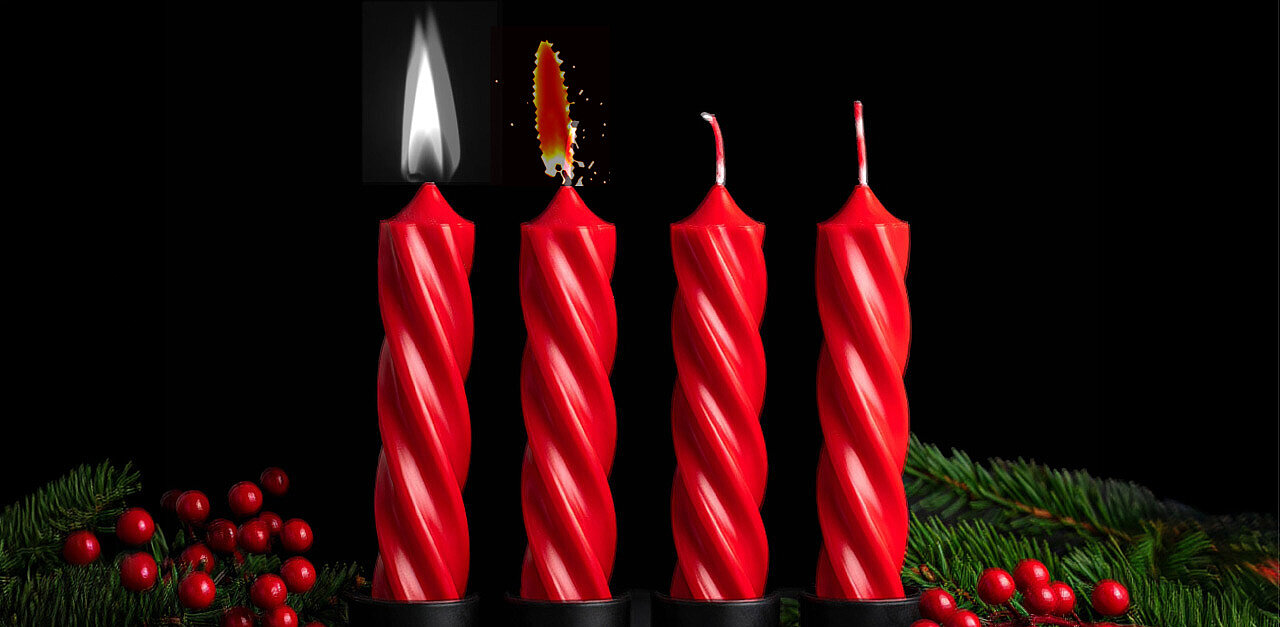
Advent, Advent, ein Lichtlein brennt. Erst eins, dann zwei …
(Advent, Advent, a little light is shining. First one, then two …)
It’s time to light our second candle on our scientific Advent wreath! Each week of the Advent season, we are lighting a special candle at attoworld and CALA, thanks to our associated DOLPHIN group led by Andreas Döpp. In the context of laser-plasma interactions, his group develops diagnostics to study plasma – the “fourth state of matter” – in high-power laser experiments. Given that a candle is essentially a weakly ionized plasma, the group has chosen the theme of the Advent wreath as a playful framework to showcase techniques normally applied to their experiments at CALA. The project was carried out by Matilde Nunes, Johannes Altmann and Marguerite Dion.
Second candle: Mapping temperatures with a hyperspectral camera
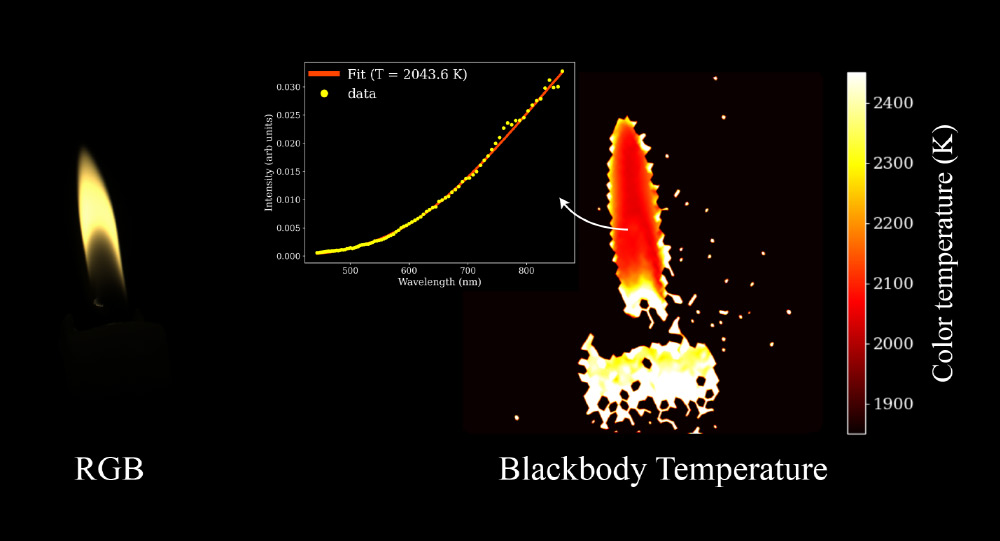
To capture the second candle, the researchers used a hyperspectral camera, which offers a significant advantage over traditional cameras. While a normal camera records only three color channels – red, green and blue – a hyperspectral camera captures a full spectrum of light, spanning a continuous range of various wavelengths. In fact, each point in the image contains detailed information about the spectral contents of the imaged light, which provides a rich dataset for analyses.
From this data, several key properties can be derived, including the temperature of the flame. This is because the spectrum of light emitted by any heated object – like the candle flame – follows approximately a predictable shape known as a black-body distribution. By fitting a black-body curve to the spectrum of every pixel in the image, the researchers were able to retrieve the color temperature of the flame at each pixel and create a two-dimensional temperature map.
A perfect black body radiator would have a temperature that matches the color temperature. However, a candle flame is not a perfect representation of a black body. This is because only small parts of the flame – the soot – are ideal black body radiators, while the rest of the flame is not. As a result, the color temperature shown is shifted, and the actual temperature is lower than the measured value.
Despite this, the measurement shows a clear trend: the temperature of the flame is higher along the outer edges than in its center. This is the case, because the outer edges are closest to the air and therefore to the oxygen, which is needed for the burning process.
While a candle might not emit a perfect black body spectrum, there are blackbody sources which almost do. They are quite useful in optic applications, since the emitted spectrum is well defined, as long as the temperature of the source is known. They are used to calibrate spectrometers or other devices that measure light in the visible and infrared range.
Stay tuned for the next week, when we reveal the next candle on our scientific Advent wreath!
Pictures: Advent candles: AI-generated / Nina Beier; Measurements and Behind-The-Scenes: Matilde Nunes, Johannes Altmann and Marguerite Dion


