Laser-driven Ion Acceleration (LION)
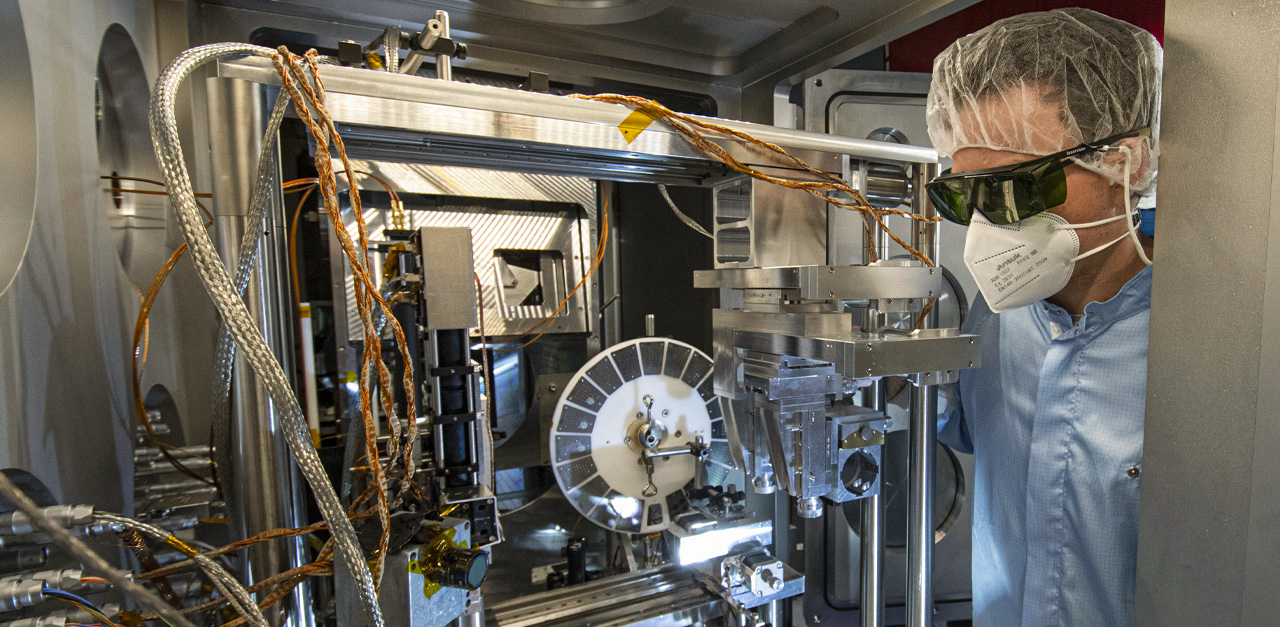
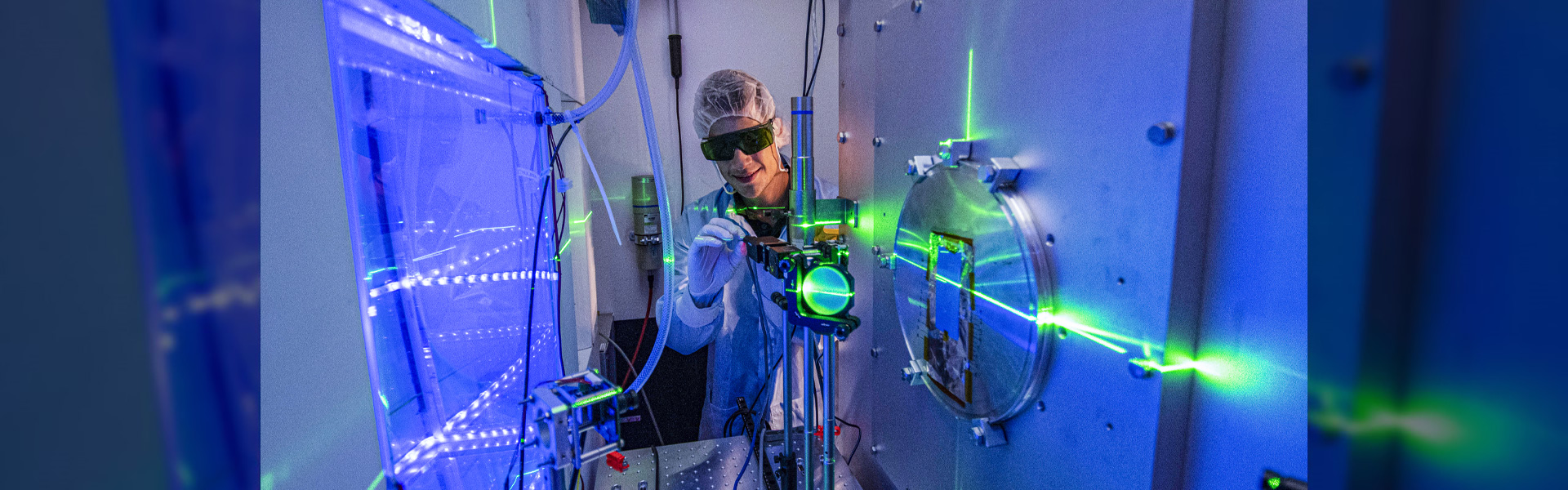
The experimental station Laser-driven Ion (LION) Acceleration investigates laser-based ion sources as a route toward compact, high-gradient particle accelerators for fundamental research and medical-physics applications.
In LION, ultra-intense laser pulses from ATLAS or PFS-pro interact with micrometre-thin targets that can be supplied continuously for high-repetition-rate operation. In the extreme electromagnetic fields of the interaction, electrons are driven forward within femtoseconds, creating strong accelerating fields that propel ions to a significant fraction of the speed of light over micrometre distances. The result is a short, bright ion bunch with distinctive temporal and spatial properties.
A central focus of LION is the reliable generation, transport, and characterization of these beams. Advanced diagnostics measure energy spectra, divergence, charge, and shot-to-shot stability—while parts of the detector and measurement technology are developed within the program itself. Downstream particle-optical beamlines (e.g. magnetic optics) enable energy selection, beam shaping, and focusing onto samples for controlled irradiation experiments.
Laser-driven ion beams already provide a valuable complement for studies of ion–matter interaction, including questions in radiation chemistry and biology and the development of concepts relevant to cancer therapy. For direct clinical application, key challenges remain—most notably long-term stability, reproducibility at repetition rate, and system integration—toward compact, cost-effective ion acceleration and beam delivery.