
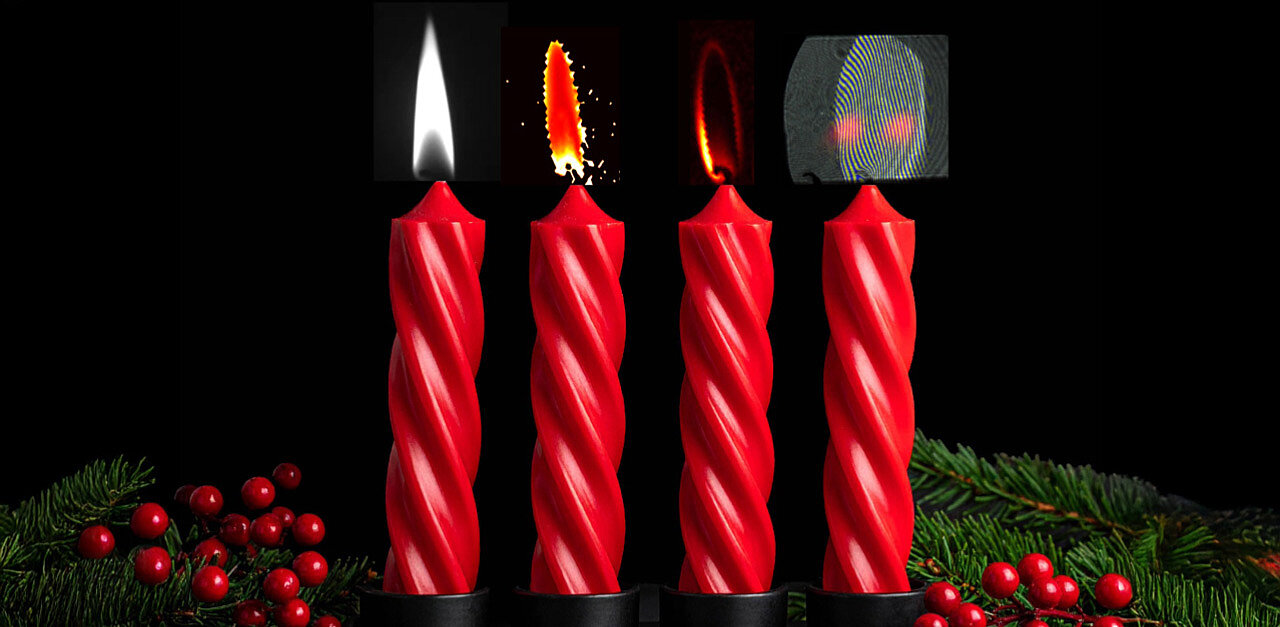
Advent, Advent, ein Lichtlein brennt. Erst eins, dann zwei, dann drei, dann vier …
(Advent, Advent, a little light is shining. First one, then two, then three, then four …)
… dann steht das Christkind vor der Tür!
(… then the Christ Child is at the door!)
With this verse, the famous German poem for the Advent season ends. And this also marks the final candle on our scientific Advent wreath at CALA. Each week of the Advent season, the DOLPHIN group of Andreas Döpp has been lighting a special candle to showcase their experimental techniques on a regular candle flame – which is, in fact, a weakly ionized plasma. Thanks to Andreas, and to his students Matilde Nunes, Johannes Altmann and Marguerite Dion, for this wonderful Advent project, which has been enlightening us in the past few weeks!
And with this, we light up our fourth and final candle …
Fourth candle: Interferometry
For the last candle flame, the researchers wanted to showcase the method of interferometry: a technique that leverages the physical phenomenon of interference to extract information. It’s what you get when waves – light waves, for example – overlap and add together, sometimes reinforcing and sometimes canceling, depending on their relative timing (phase).
An interferometer exploits this by splitting a (light) beam, sending it down two different paths and then recombining the two beams to create an interference pattern. By analyzing this pattern, researchers can extract detailed information about anything the light passed through – in this case, a candle flame.
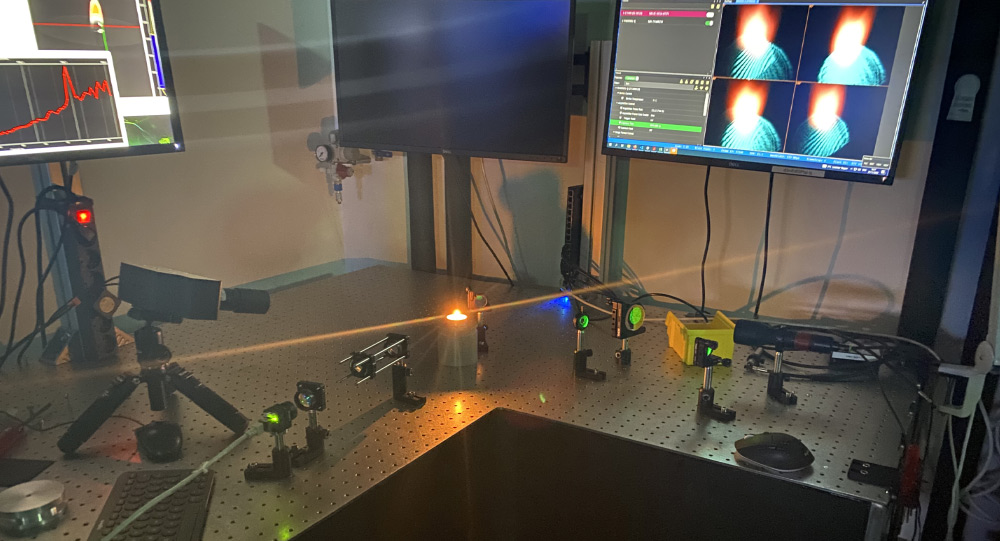
In their experiment, the students of Andreas Döpp used a Nomarski interferometer equipped with a Wollaston prism. A laser diode beam was sent through the candle flame, followed by the prism which separates the incoming light into two beams with orthogonal polarizations (0° and 90°). These beams were then recombined and recorded by a polarimetric camera, which simultaneously measures light at four polarization angles (0°, 45°, 90°, and 135°).
The two beams were recombined with a slight sideways offset, which produces interference patterns in the 45° and 135° polarization images. The image shown corresponds to the 135° polarization channel.
As the laser light passes through the candle flame, its propagation is altered, which affects the resulting interference pattern. By analyzing this pattern, one can, in principle, determine how the refractive index varies across the flame.
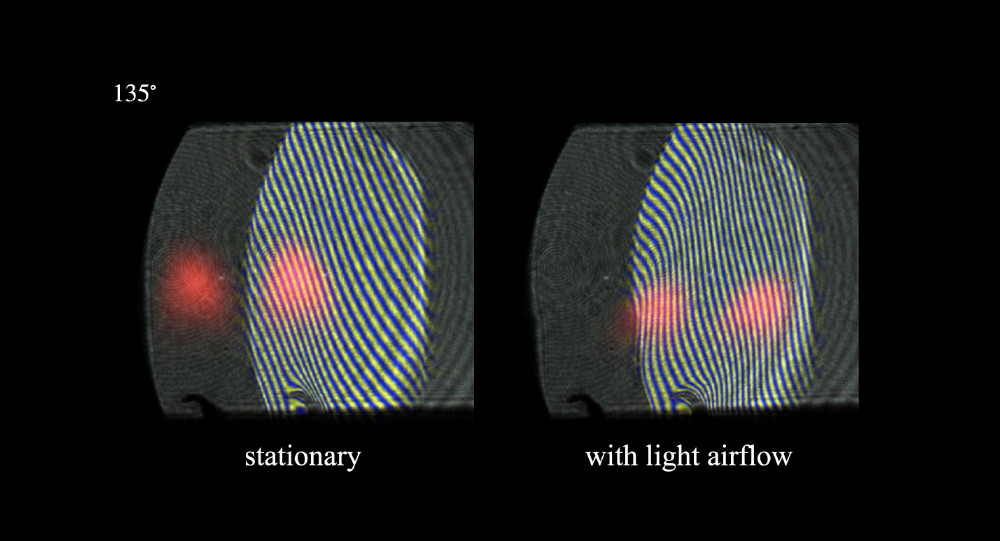
When the candle flame was gently perturbed by a light airflow, the interference patterns changed and became wavier (see images). These changes indicate local variations in the flame’s refractive index, which correspond to differences in density within the flame.
While the candle setup was just a proof of concept, this technique can be used to obtain information about the plasma density of the plasma induced by high power laser-plasma accelerators. Using interferometry, one can observe subtle variations in the structure of the flame that are completely invisible to the naked eye. Even small movements of hot gas and density differences become detectable, highlighting the capability of this technique for detailed plasma diagnostics.
And with this, we close the final chapter of the scientific Advent wreath – enjoy your holidays!
Pictures: Advent candles: AI-generated / Nina Beier; Measurements & Behind the Scenes: Matilde Nunes, Johannes Altmann and Marguerite Dion


